Five Steps to Design a House: A Guide for PNW Homeowners
Designing a home from the ground up is one of the most rewarding—and personal—projects you'll ever take on. Whether you're moving from Seattle, downsizing after retirement, or building your forever home on family land, the Western Puget Sound offers a beautiful setting for intentional living. With wooded lots, coastal views, and a slower pace of life, it’s the perfect place to create a home that reflects your values and lifestyle.
At Studio Kamppari, we specialize in Scandinavian-inspired design that emphasizes simplicity, warmth, and natural materials. If you're considering designing a home in Kitsap County or its surroundings, here is what to know before you begin.
1. Start with the Land
Every great home design starts with understanding the land. Kitsap County has a wide variety of properties—wooded acreage, in-town lots, waterfront parcels—each with its own opportunities and constraints.
Site Questions
Site orientation
Where does the sun rise and set, and how does light move across the site throughout the day? Thoughtful orientation can dramatically improve comfort, energy performance, and daily enjoyment of the home. Heavily wooded lots—whether on your property or adjacent parcels—can significantly impact solar access, daylighting, and even where outdoor spaces feel most inviting.Topography:
Flat, dry sites are generally the most straightforward and cost-effective to build on. Sloped sites can inspire beautiful, site-responsive architecture, but they often come with higher construction costs. Proximity to steep slopes, wetlands, shorelines, or other critical areas may also trigger required buffers and setbacks, which can substantially reduce the buildable area.Views and privacy:
Early on, it is helpful to identify views you want to capture—trees, water, sky, or distant landforms—as well as views you may want to soften or block, such as neighboring homes or roads. Window placement, outdoor rooms, and building orientation all play a role in balancing openness with privacy.Zoning and setbacks:
Check with your local planning department (city or county) early in the process to understand what is allowed. City lots often permit building relatively close to property lines, and existing neighborhood patterns can offer helpful clues about what is possible. Rural lots, by contrast, typically have much larger required setbacks—sometimes 50 feet—which can significantly influence siting, access, and overall design strategy.
Tip#1: You can involve your architect as early as possible—even before you purchase land. We can help evaluate site potential and avoid costly surprises.
Tip#2: read our article on buying land.
2. Clarify Your Vision and Lifestyle
Your home should make your life easier. It should support how you want to live—not just today, but as your life evolves. We encourage our clients to think beyond square footage and bedroom counts, and focus instead on how their home can help them live a better life.
A helpful place to start is by imagining a “good day at home.” How do you move through your house? Where do you naturally gather, retreat, or work? What parts of your current home feel effortless, and which ones create friction?
Ask yourself:
Do you need space for guests, hobbies, or working from home?
How much maintenance are you comfortable with?
Why do you want to build versus buying an existing house?
For families:
How might your needs change as children grow—privacy, homework zones, guest rooms, or future flexibility?
What parts of family life feel chaotic today, and how could the home help smooth those moments?
For remote workers:
How many people work from home, and how often?
Do you need focused, quiet space or the ability to move between different work settings throughout the day?
How important are daylight, views, and a sense of separation between work and home?
Will your workspace need to adapt over time (clients visiting, dual workstations, future flexibility)?
For downsizers:
What do you love most about your current home, and what are you ready to leave behind?
Which spaces do you use every day, and which ones sit mostly unused?
How much storage do you realistically need, and for what?
How important is ease of movement, accessibility, and long-term comfort?
What does “less, but better” mean to you in terms of space, light, and materials?
These are your needs and wants. Needs define the minimum requirements, while wants shape the personality and character of your home.
3. Align Your Budget with Your Priorities
In Kitsap County, the cost to build a custom home typically ranges from $300 to $900 per square foot, depending on factors like design complexity, material choices, and site conditions; for a super fancy house, these numbers can be double or triple. It is essential to approach the process with a clear understanding of your total investment—not just construction costs. Your overall budget should account for everything from design and permitting to site work, finishes, and landscaping.
Total Project Costs:
Construction costs
Design and engineering fees
Permitting and site prep
Landscaping, furniture, and finishes
Finance costs
We help our clients prioritize what matters most—often encouraging quality over quantity, and light-filled simplicity over unnecessary square footage.
Tip#1: read our article on Building Costs in Kitsap County
Tip#2: the most cost effective house is a simple rectangle located on a dry, flat site.
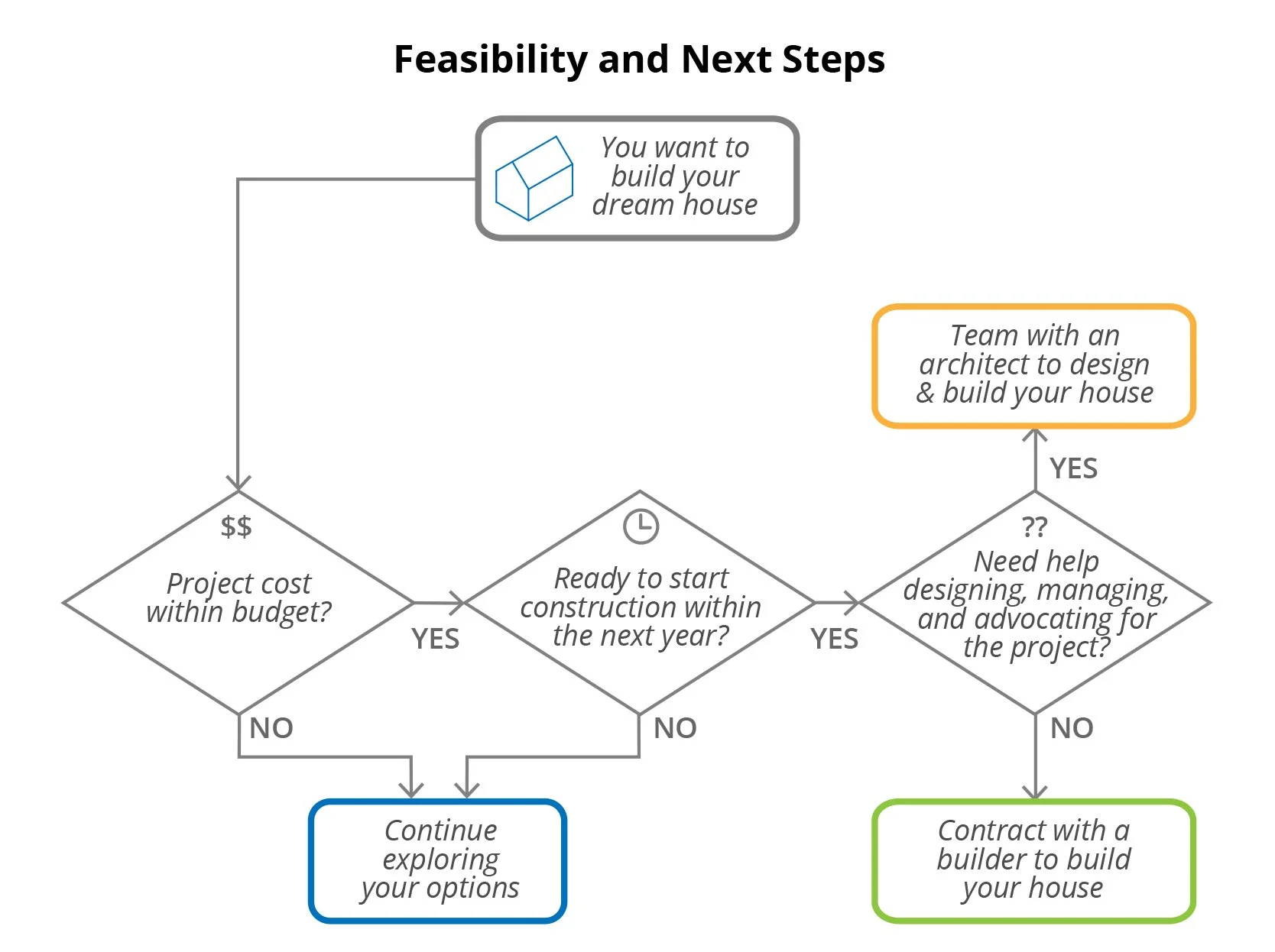
4. Choose the Right Team
Designing a home is a deeply collaborative process. Surround yourself with people who listen well, communicate clearly, and share your values.
We recommend:
A licensed architect who understands both the technical and aesthetic aspects of design, homebuilding and permitting
A licensed builder who is experienced with custom homes, collaborative, detail oriented, and has long-standing subcontractor relationships
You, your architect, and your builder form the core project team. Many projects also require additional consultants, such as a structural engineer, civil engineer, landscape architect, or other specialists depending on the scope of work. The architect’s role is to coordinate the efforts of these consultants and integrate their work into a cohesive design. At Studio Kamppari, we work with clients from concept through construction, coordinating with trusted professionals to bring your vision to life.
Tip#1: It is common for the owner to have separate contracts with the builder and the architect. During construction, the architect acts as the owner's advocate.
Tip#2: Hire your Architect first, and they can then help you interview and select a builder based on your project needs.

5. Embrace the Process
Designing a home in Kitsap County takes time. It can take 12–18 months from the first sketches to move-in, influenced by permitting and construction realities. It is not a race. It is an experience. When approached with patience and curiosity, the process becomes an opportunity to make better decisions, respond to the site, and create a home that will serve you well for decades.
Our Three C’s of the Design Process:
Communication
Designing a home involves thousands of decisions, both large and small. As your architect, we know when to ask the right questions, helping you make informed choices, avoid decision fatigue, and keep the process moving in a way that feels thoughtful and rewarding.
Clarity
We use iterative sketches, models, and material studies to test ideas and ensure each design decision moves the project in a desirable direction. By the end of design, we produce a well-coordinated set of construction drawings and specifications that clearly communicate the design and align your vision with what ultimately gets built.
Care
It is surprisingly hard to make something feel simple. Fussy is easy—refined simplicity takes time, rigor, and restraint. We pay close attention to proportion, flow, and building performance, ensuring your home is not only beautiful, but durable, efficient, and a pleasure to live in. We genuinely love what we do, and we take pride in delivering designs that look, feel, and perform well for the long term.
Ready for your Next Step?
If you’re dreaming of a home that’s warm, minimal, and designed for how you want to live, we’d love to talk. Studio Kamppari offers full architectural services for custom homes and remodels throughout Kitsap County — send us a note.